Assemblymember Aguiar-Curry Unveils COMPETE Act, co-sponsored by CFC, small business groups, labor groups and many others, to Update California Antitrust Laws
Supporters say clearer laws will strengthen competition, affordability, and economic growth
FOR IMMEDIATE RELEASE: February 18th, 2026
(SACRAMENTO, CA) — Assembly Majority Leader Cecilia Aguiar-Curry announced Assembly Bill 1776 (AB 1776)—the Competition and Opportunity in Markets for a Prosperous, Equitable and Transparent Economy (COMPETE) Act—at a press conference joined by labor, small business, consumer, and economic justice leaders. The COMPETE Act promotes a fair economy by strengthening competition, opportunity, innovation, and entrepreneurship.
“When there’s less competition, prices go up and people pay more for goods and services,” said Assembly Majority Leader Cecilia Aguiar-Curry (D-Winters). “The COMPETE Act updates our antitrust laws so businesses can compete fairly, ideas can succeed, and Californians aren’t stuck with higher prices and fewer options.”
The COMPETE Act updates California’s antitrust laws to reflect today’s economy to provide clear, predictable standards that support innovation, responsible growth, and fair competition. The bill codifies the unanimous recommendations of the California Law Revision Commission following three years of expert study, public input, and 17 public meetings, responding to increased consolidation across major industries. AB 1776 clarifies that anti-competitive conduct by single companies can violate state law and reaffirms California courts are not bound by federal antitrust case law, while preserving lawful business growth, investment, and scale. By focusing narrowly on harmful conduct that raises costs, suppresses wages, and limits opportunity, the COMPETE Act aligns California with 34 other states and strengthens competition without penalizing success.
Consumer advocates underscored how consolidation directly impacts affordability and choice. “Consumers are increasingly being squeezed by monopolies in all sorts of damaging ways, from higher prices and out of control fees to a lack of meaningful competition in key industries and lower wages and benefits,” said Executive Director Robert Herrell, Consumer Federation of California. “The COMPETE Act will help provide California with the tools to turn this around by enhancing competition, innovation and protecting small businesses and consumers from monopolists, oligopolists, and their apologists.”
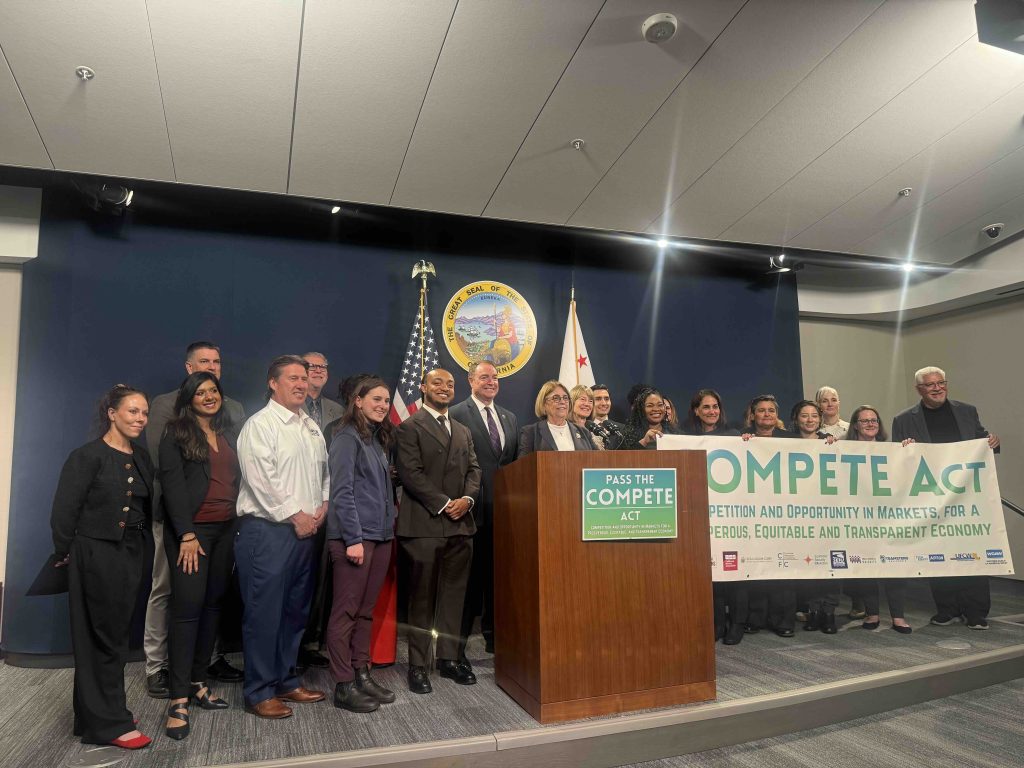

Labor leaders emphasized how market concentration weakens workers’ bargaining power and erodes job quality. “Big companies are monopolizing industries and their profits are attempting to also dominate the workforce by flexing loopholes and gaps in the law to undercut good paying union jobs and threatening the rights of workers across California. Enough is enough. California should not be a playground for corporations to bully their way towards rapid expansion in a vacuum while working people are left behind,” said Secretary-Treasurer Dale Wentz, Teamsters Local 150.
President Mark Ramos, UFCW Western States and Local 1428 said, “In my 30-plus years in the industry, I have seen firsthand the effects of market consolidation. I was able to buy a house as a union grocery worker, but that’s a far-off dream for our members now. Consolidation enables employers to suppress workers’ wages. UFCW is proud to support the COMPETE Act to see workers’ paychecks grow.”
Small business owners, which make up 99.9% of California businesses and employ roughly half of the state’s private-sector workforce, are increasingly vulnerable to exclusionary practices under outdated competition laws. In 2026, many small business owners are squeezed by rising costs such as healthcare and tariffs while competing against corporations with vast resources, market reach, and technological advantages. “Outmatched in pricing power, talent recruitment, and digital scale, many are forced to survive on thinner margins in a system built for giants,” said California Director Bianca Blomquist, Small Business Majority. “In a market dominated by corporations with limitless resources, the COMPETE Act is requisite to restoring fair competition and gives small business owners, the workers they hire, and their local communities a fighting chance.”
Advocates also highlighted the bill’s balanced, pro-growth approach. “Californians are feeling the squeeze of higher prices, lower wages, and fewer choices,” said Chief Advocacy Officer Samantha Gordon, TechEquity. “The COMPETE Act is a common-sense step to rein in anti-competitive conduct and ensure competition creates opportunity for everyone. California can lead the way in making sure markets work for people—not just the biggest corporations.”
Bill co-author, Assemblymember Damon Connolly (D-San Rafael) added, “At a time when big corporations dominate markets and are working to strengthen their monopolies, AB 1776 is a critical step towards creating a robust marketplace for consumers, workers, and small businesses. As the affordability crisis grows, and big corporations increase their power and profits, we need strong pieces of legislation like AB 1776 to create an even playing field with opportunities for all hardworking Californians.”
By grounding reform in expert, unanimous recommendations and prioritizing clarity and predictability, the COMPETE Act strengthens competition while supporting innovation, entrepreneurship, and responsible economic growth—helping ensure California’s economy remains dynamic, competitive, and affordable.
###
About the Consumer Federation of California: The Consumer Federation of California is a nonprofit advocacy organization that, since 1960, has been a powerful voice for consumer rights. CFC campaigns for laws and regulations that place consumer protection ahead of corporate profit, either in front of the California Legislature or before state agencies in support of consumer regulations.
Tags: AB 1776, Antitrust, California Law Review Commission, Economy